

Sharp panels are showing up where spare parts live
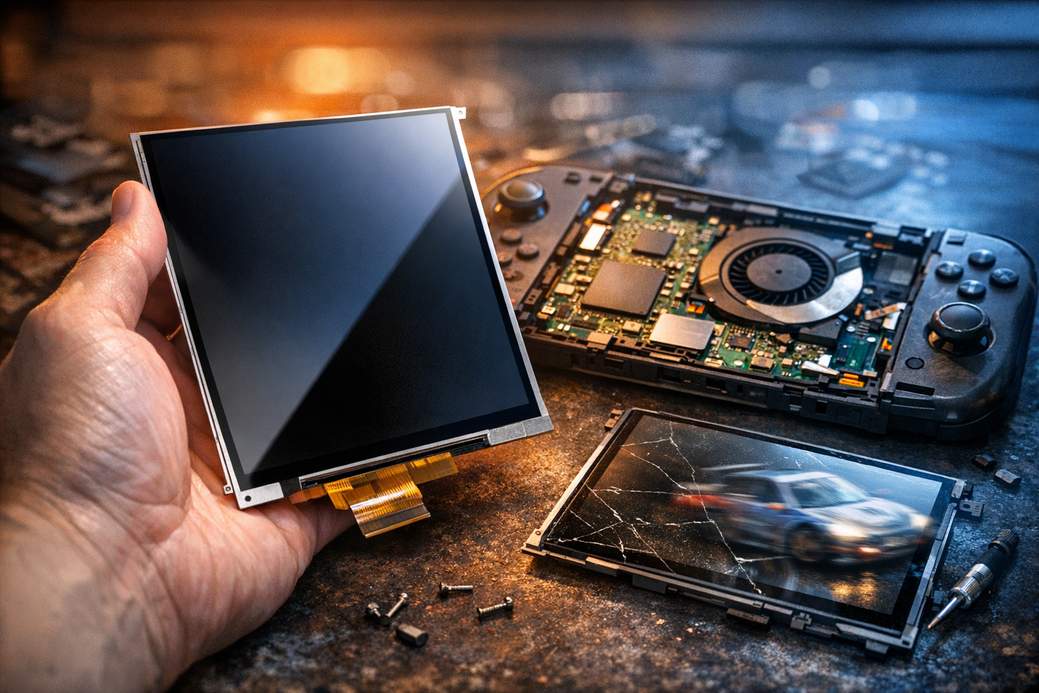
If you poke around Chinese parts stores (yes, the internet is nosy), a Sharp LCD labeled LS0DAS7081 has started to appear with annoying frequency. A part going from “once-in-a-blue-moon” to “on every shelf” usually means someone has moved from prototype to production—so heads up: this is not random.
From rarity to mass production (the obvious implications)
Historically, when replacement bits start trickling into Shenzhen catalogs, it’s a sign we’re past early sampling and into larger-scale manufacturing. That fits with earlier rumors: a Sharp module showed up months ago as a one-off, and now there’s suddenly stock available. That usually means either full production has begun or is imminent.
Nintendo reportedly wants to crank out a lot of units in the coming fiscal year, so having a second display supplier is logical. There’s also the timing: Nintendo’s recent price shuffle suggests they’re juggling component costs, and adding another supplier for an expensive part like the big screen helps spread the risk.
What we actually know (and what we don’t)
Let’s be realistic—there aren’t many confirmed facts, but the useful bits are these: the Sharp panel appears to be a 7.9-inch 1080p LCD like the current screen, it has a different circuit board/connector layout so it’s not a drop-in replacement, and retailers selling it warn it won’t work with the older model without changes.
What’s still up in the air: will this new assembly fix that annoying ghosting some players complain about? Will it fully replace the Innolux panel or sit alongside it? Nobody’s confirmed those points yet.
The Sharp-versus-Innolux twist (don’t get too excited)
Here’s the kicker: earlier sleuthing suggested Innolux might have been assembling panels using Sharp-produced LTPS glass in the first place. If Sharp simply takes over the full module assembly, the change could be more about who is doing the bolting and testing than a dramatic leap in display performance.
In plain terms: assembly location alone isn’t likely to shave down that 17-millisecond response time people gripe about, so don’t expect miracle-level fixes just from a new factory label.
Ghosting, OLED rumors, and realistic expectations
Gamers have been griping about ghosting in some handheld games after long use, so any screen tweak gets extra attention. Rumors about an OLED Switch 2 have been floating around, but the parts showing up are more LCDs, not OLED modules—so it looks like Nintendo isn’t rushing to OLED for this refresh.
That’s not a condemnation—if a console is selling millions of units, sticking with a tried-and-true LCD and optimizing supply chains makes business sense. If the LS0DAS7081 does show up and fixes ghosting, though, that would be a sneaky, very welcome quiet update.
The bottom line
Sharp panels appearing in parts shops are a noisy hint: production is probably ramping, and Nintendo may be lining up multiple suppliers to hit big unit targets. But don’t swap your expectations for miracles just yet—this could be an assembly shuffle rather than a tech revolution. We’ll know more when someone cracks open a unit with the Sharp module installed and tests it properly.